
Hemp Bioplastic Meaning
Let’s know about Hemp Bioplastic in details. The very first of the plants planted by humans was the Cannabis Sativa L. or commonly known as Hemp. Unlike marijuana, it does not produce any psychoactive effects that could play with the human mind or corrupt the mechanism.
Hemp is just not an agricultural crop but a high performance industrial resource that has qualities that values sustainability provides ecological support for the environment. It has properties that could replace petroleum plastics in many sectors whose production and disposal have a much lower environmental impact. Every part of the plant- from seed to stalk- everything has a purpose, supporting the transition to a circular and sustainable manufacturing system with reduction to fossil fuels, reduced pollution and sustainability all over.
What is hemp bioplastic?
With sustainability in sight- hemp also contributes towards the ecosystem by trying to replace the plastic industry all together. Produced from the cellulose of the hemp plant using only natural renewable plant source instead of traditional petroleum Hemp bio-plastic is the perfect eco- solution.
The hemp plant is an ideal source for making bio-plastic as it contains high cellulose content (approx 60-70%). Hemp bio-plastic are of different kinds such as-
- Cellulose Acetate– Transparent, glossy and one the oldest and most traditional form of bio-plastic formed from the chemically modifying the cellulose extracted from the hemp plant. It is resistant to oil, grease and UV radiation. Since it is Biodegradable (depending upon the processing) and a very lightweight and durable product it is used in multiple fields such as- Eyeglass frames, films and transparent sheets, tool handles, buttons and accessories and medical packaging.
It is great replacement to petroleum plastic and provides a better ecological performance. - Cellophane– A flexible and strong product, produced from the conversion of cellulose extract from hemp plants into a soluble compound and then regenerating into biodegradable solid sheets. With zero micro plastic production, it provides an excellent barrier to oxygen, grease and flavors and that’s why it is used in food packaging and with its glossy transparency properties it is used as adhesive tapes and wrapping papers.
It can help control the heavy contribution of global wastage from food packaging industries. - Bio-composites– With the strength and durability used in automotive parts, construction materials, furniture etc Bio-composites are materials created by combining hemp cellulose and fibers with natural biodegradable resins. The flexible and lightweight material can be molded into any shape suitable for environmental benefits.
Companies like BMW and Mercedes have already adopted hemp bio-composites in multiple car models. - Hemp Fiber-Reinforced Polymers– A composite of either bio based or partially petroleum based plastics that are reinforced with strong hemp Fibers to improve both ecological and mechanical strength. They are like supporting actors to bring in lightness, flexibility and renewable and biodegradable properties to existing plastics and replace materials like fiber glass.
They help reduce carbon footprint from appliances like machine covers, sport gear, automotive components etc. bringing in better impact resistance and lighter finished products.
Also read: What are Hemp Textiles? Is Industrial Hemp Fabric Good?
Is Hemp bioplastic sustainable?
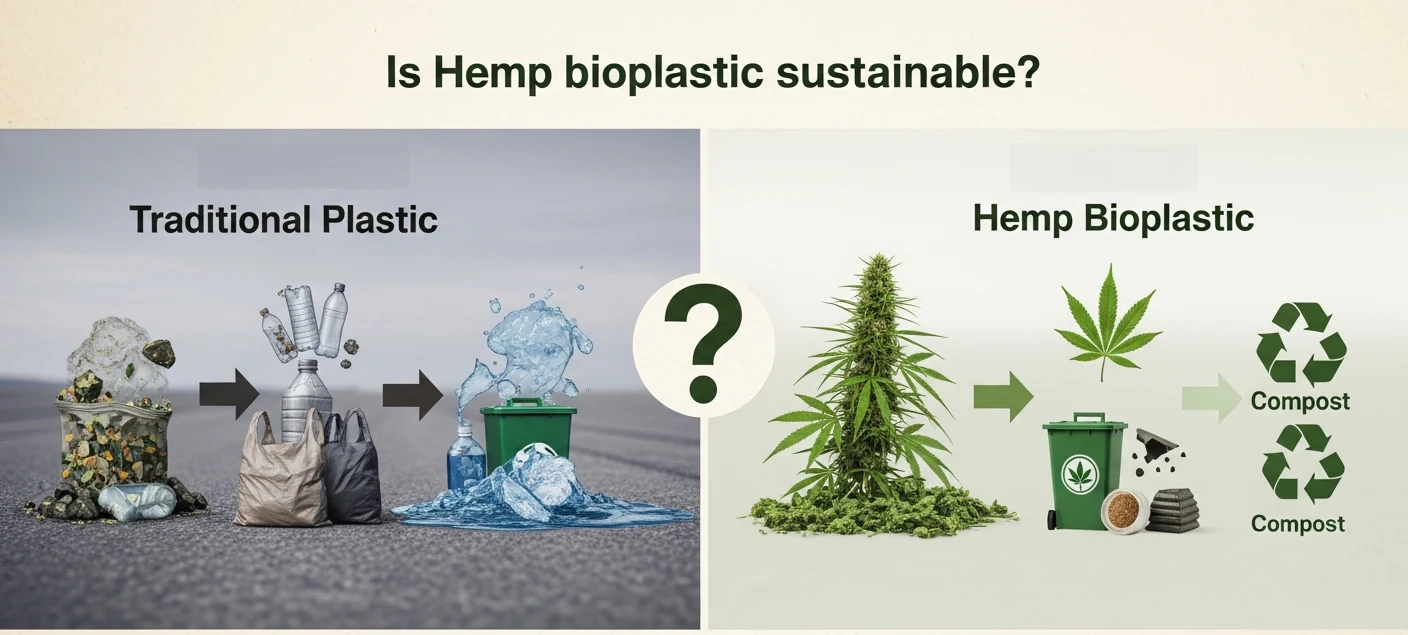
- Hemp is one of the few plants that grow with less water and as quickly as 3-4 months, unlike petroleum which takes millions of years to form, without the need of chemical pesticides
- Encourages soil health by retaining moisture and nourishment, preventing soil erosion and dehydration.
- The environment benefits from low carbon emission – hemp absorbs more CO2 from the atmosphere than many other plants, helping fight climate change.
- The decomposition is done within 3 to 6 months, depending on the processing and environment – far better than plastics which take hundreds of years.
Is hemp plastic better than regular plastic?
- Regular plastic is made from petroleum based non renewable products while hemp bio-plastic is completely plant based and renewable.
- Since plastic can last for centuries to come, hemp bio-plastics degrade within months.
- Bio plastics leave little to no carbon emission whereas regular plastics have very high carbon footprint.
- Regular plastics release toxic chemicals in the environment where as bio-plastics are eco-friendly and non harmful.
In short – hemp plastics can be stronger, lighter and durable. It is safe for the environment and is a convenient and ideal replacement for plastics in industrial areas.
What are the limitations for hemp bioplastic?
While promising, it still faces certain challenges, such as-
- High Production cost– To make something organic and biodegradable, a lot of resources and production factors are taken into account and that costs more than what petroleum plastics are made of.
- Limited manufacturing infrastructure– Since it is a growing concept it hasn’t reached maximum widespread and awareness thus limited manufacturing.
- Not all types degrade easily– Some hemp based plastics are blended with other biodegradable polymers and need specific composition conditions.
What are the solutions to limitations for hemp bio-plastic?
- Scale up production facilities
- Supporting green alternatives can make bio-plastics cost-competitive.
- Invest in regional processing hubs
- Improve waste management systems
- Spread public awareness – conducting seminars, exhibitions and social media experiments.
FAQs about Hemp Bioplastic
Q. 1 – How hemp is bioplastic made?
- The process typically involves:
- Extracting cellulose from hemp stalks
- Converting it into materials like cellulose acetate
- Forming it into films, fibers, composites, or molded products
Q. 2 – Does hemp bioplastic release micro-plastics?
- Biodegradable hemp plastics generally do not release micro-plastics during decomposition, making them much safer for the environment than traditional plastics.
Q. 3 – Is hemp bioplastic safe for food packaging?
- Yes. Hemp-based plastics can be food-safe, non-toxic, and ideal for packaging, films, and disposable cutlery when manufactured to appropriate standards.
Trending Products

Hidkat Mens Corduroy Casual Pants F...
Chemo Headwear Head Wraps for Cance...

adidas Golf Men’s Standard Ul...

Gafeng Mens Linen Pants Yoga Beach ...

morhuduck Women’s Waffle Knit...
Shopoholic Fashion Mens Striped Gra...

Minibee Women’s Linen Blouse ...

Women’s Tube Tops Summer Casu...
LIVING LIBATIONS – Organic He...