
The first phase of a large hempcrete-based care-home complex being developed by Nepal-based Shah Hemp Inno-Ventures (SHIV) is nearing completion, marking the latest milestone in a decade-long effort by founders Dhiraj Shah and Nivedita Bansal Shah to build commercial and social infrastructure with hemp across South Asia.
The project, in Meerut, Uttar Pradesh, India, spans roughly two acres and includes a planned 40,000-square-foot complex built with hempcrete walls around reinforced concrete framing. The smallest building in the development, at roughly 7,000 square feet, has now been completed, according to Dhiraj Shah.
SHIV trained a crew of 10 workers on site who have now shifted to begin work on the main building, which is targeted for completion by September 2027.
Practicality at scale
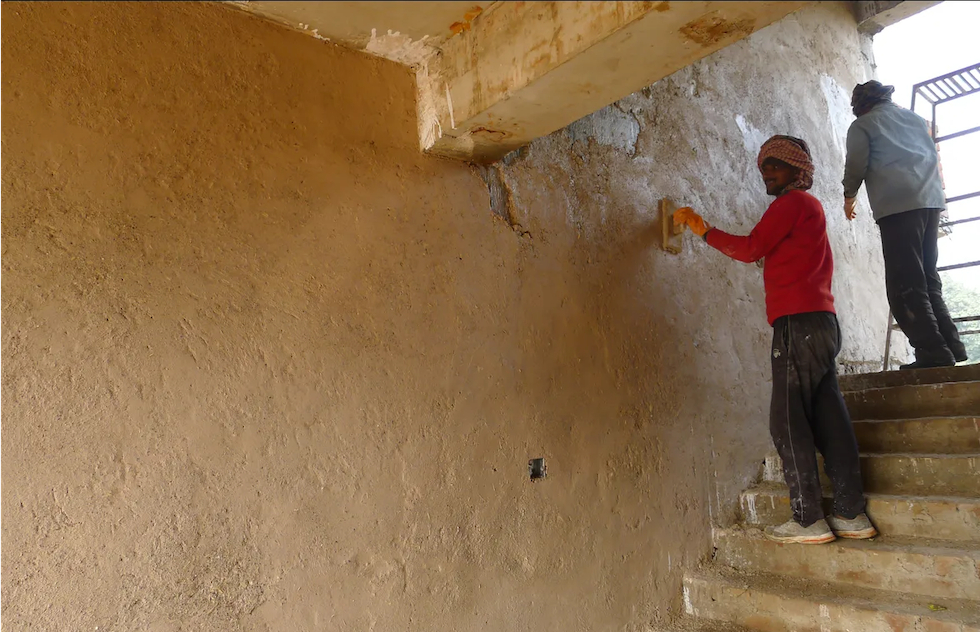
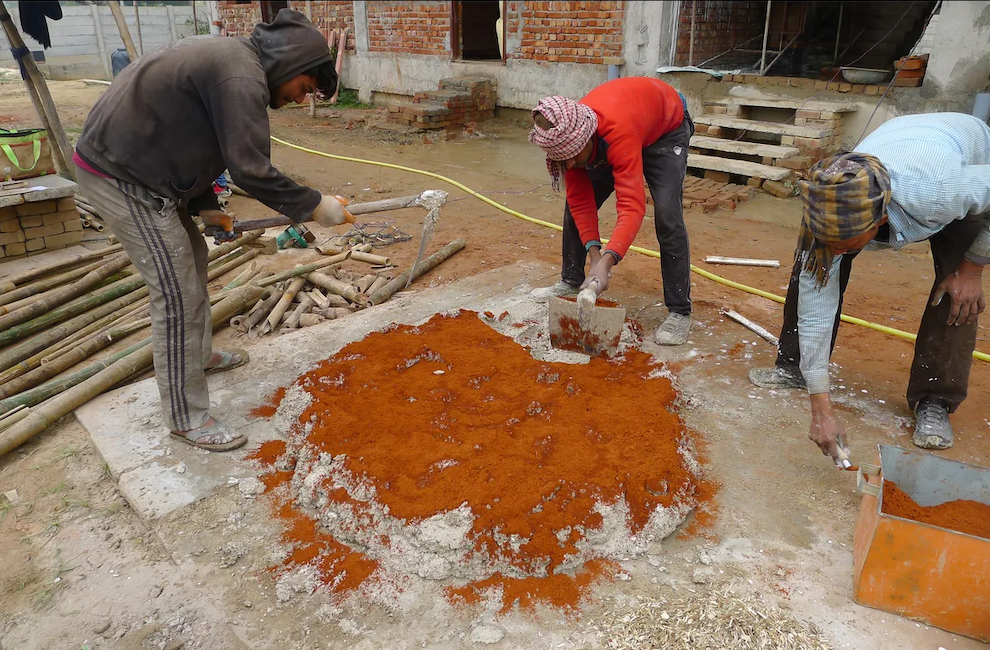
Shah said the project demonstrates hempcrete’s practicality at a larger scale, and how it can reduce the use of conventional materials while improving thermal and environmental performance. Most of the total external and internal wall space was cast in hempcrete using the form-infill method.
“Hempcrete is especially suitable for care facilities because of its thermal insulation, breathability and natural properties,” Shah said. “We were able to save around 20% of the concrete material that otherwise would have been required for the project,” Shah said. Some brick is also being used in the construction.
Long path
The work reflects a long-running vision first outlined by the Shahs after Nepal’s devastating 2015 earthquake, when they first proposed that hemp-based building materials could help provide affordable, resilient housing and public facilities in the Himalayan nation.
They founded SHIV to develop commercial applications for locally sourced hemp while also supporting economic opportunities in rural communities. The company collects hemp “wildcrop” from local villagers for a growing portfolio of products in construction, health and beauty, and textiles.
The Shahs have also focused heavily on women’s economic development initiatives tied to hemp processing and production.
Care facility
The India project, under the Meerut Children Welfare Trust, is designed as a “Life Care Home” for elderly residents and adults with mental disabilities who may no longer have long-term family support. The concept responds to the breakdown of India’s traditional joint-family structure, under which extended families historically cared for vulnerable relatives across generations.
Bansal Shah said the project aims to create a more humane alternative to institutional shelter homes by combining rehabilitation, skills development and community living.
“This is about putting hemp to work for social needs,” she said. “The idea is to create an environment where elderly people and mentally challenged residents can support each other emotionally while living with dignity and purpose.”
Highly personal
For Bansal Shah, the project is highly personal. Her father founded the Meerut Children Welfare Trust in 1995 after struggling to find support services for her eldest brother, who has cerebral palsy. The Trust later established a school and eventually launched teacher-training programs in special education before advancing the Life Care Home concept.
The Trust is funding all materials for the project and has drawn support from philanthropists and corporate social responsibility (CSR) programs, according to Bansal Shah, who said the organization’s longstanding reputation has helped attract donations.
SHIV’s role – provided pro bono – extends across contracting, consulting, worker training, construction oversight and sourcing materials at the best possible prices. Hemp hurd for the project is being supplied by Gohemp, an Uttarakhand-based startup operating out of the TIDES BioNest incubation center at the Indian Institute of Technology Roorkee. Ukrainian builder Sergiy Kovalenkov of Kyiv-based Hempire helped with training the crew during a recent visit to the project.
Earlier work
The care-home complex represents SHIV’s largest hempcrete development to date. The company has completed several public medical facilities in rural Nepal over the years, including a clinic and a hospital, and built homes for distressed villagers following earthquake damage – all helping to establish the Janakpur-based operator as one of the few in South Asia consistently carrying hemp construction concepts through to completion.
Commercial adoption of hemp-based construction has remained relatively limited in South Asia due to regulatory uncertainty, lack of processing infrastructure and the specialized labor required for hempcrete construction.
SHIV has attempted to address some of those constraints by building local supply chains tied to naturally occurring hemp in Nepal while developing practical demonstration projects that can be replicated elsewhere in the region.
“The journey has been long, but we have always believed hemp could become part of the solution for sustainable development in our region,” Shah said.
Trending Products

Hidkat Mens Corduroy Casual Pants F...

Chemo Headwear Head Wraps for Cance...

adidas Golf Men’s Standard Ul...

Gafeng Mens Linen Pants Yoga Beach ...

morhuduck Women’s Waffle Knit...
Shopoholic Fashion Mens Striped Gra...

Minibee Women’s Linen Blouse ...

Women’s Tube Tops Summer Casu...
LIVING LIBATIONS – Organic He...